Investment Portfolios
Bliss tracks investment holdings with FIFO lot calculation, multi-currency PnL, and real-time pricing.
How it works
When you import or create buy/sell transactions with a ticker symbol, the portfolio pipeline processes them automatically:
- Portfolio initialization — Creates or updates portfolio items for each (ticker, account) pair. The same ticker held in two different brokerage accounts produces two independent portfolio items with separate lot stacks and PnL tracking.
- FIFO lot calculation — Each buy creates a lot; sells consume the oldest lots first, scoped to that account.
- FX rate capture — Each lot records the buy-date exchange rate for accurate cross-currency PnL.
- Valuation — Current prices fetched via a 4-stage waterfall: memory cache, live API, 7-day DB lookback, manual value fallback.
The pipeline runs automatically whenever transactions change, triggered by the event-driven architecture.
Data-quality flag: If a sell transaction has no matching buy lot in the same account (e.g., a cross-account transfer recorded as a close), the portfolio item is flagged with
hasLotMismatch: true. This warning appears in the transaction form to prompt correction.
Setting up investment accounts
Investment accounts work like any other account but hold transactions with ticker data. You can:
- Create them via the UI (Accounts > Add Manual Account)
- Include them in your tenant seed script
- Import transactions with ticker data via Bliss Native CSV
Importing investment transactions
The key columns for investment transactions in the Bliss Native CSV format:
transactiondate,description,debit,credit,account,category,ticker,assetquantity,assetprice,currency
2024-01-15,Buy AAPL,5000,,Schwab,Stocks,AAPL,25,200,USD
2024-03-20,Sell AAPL,,3200,Schwab,Stocks,AAPL,10,320,USD
2024-06-01,Buy VWCE,2000,,Revolut Investment (EUR),ETFs,VWCE.DEX,15,133.33,EUR
When a ticker is present, Bliss automatically looks up the security metadata from Twelve Data (name, exchange, type).
Portfolio dashboard
The portfolio page shows total value, asset allocation, and holdings grouped by type.
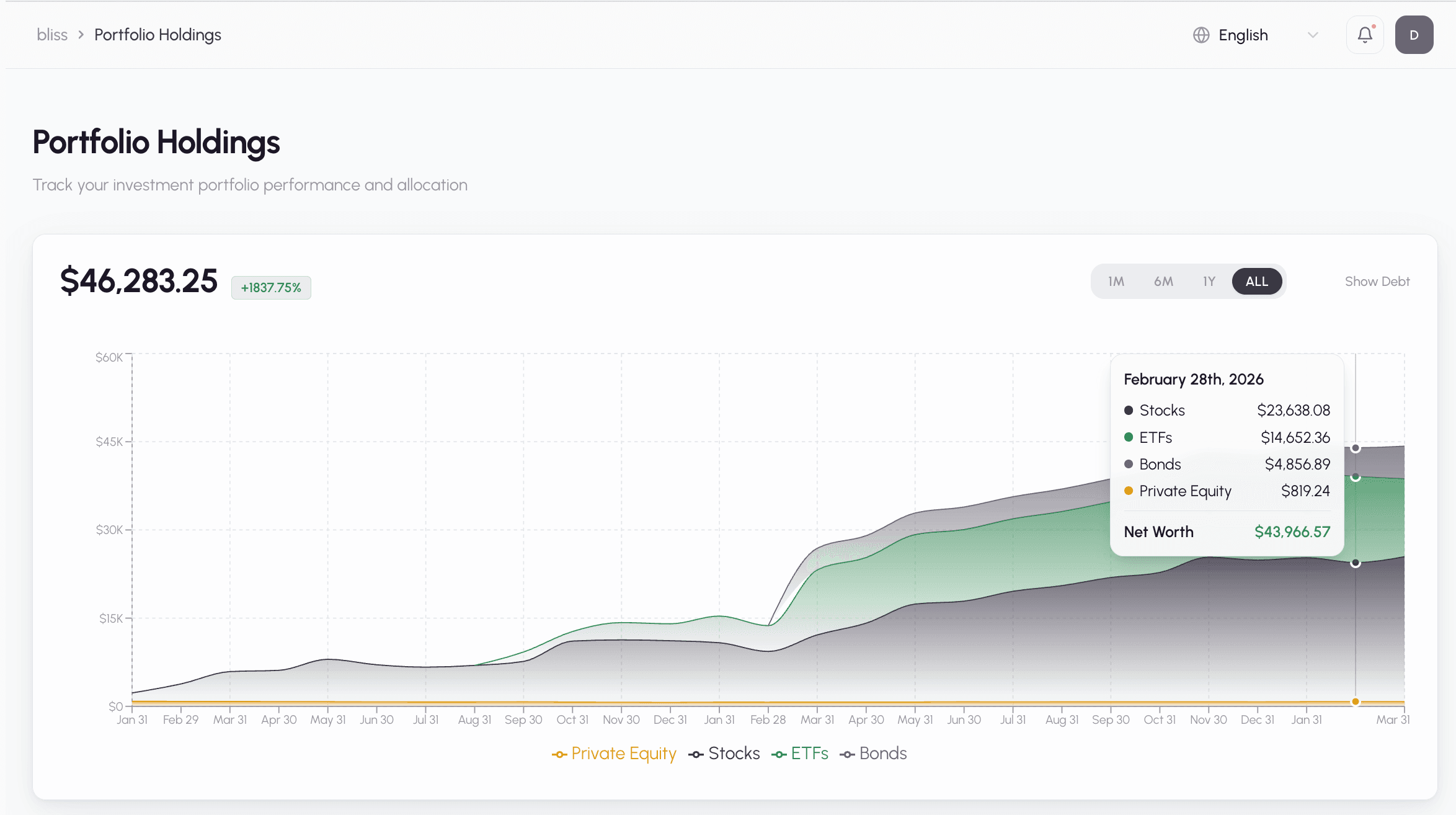
Supported asset types: Stocks, ETFs, Crypto, Bonds, Real Estate, Private Equity, Pension Plans, and more.
Enabling live prices
For real-time stock pricing, add a Twelve Data API key:
TWELVE_DATA_API_KEY=your_api_key
STOCK_PROVIDER=twelvedata
Without an API key, the portfolio still works — it uses the last known price from your transactions or manual value updates.
Manual value assets
For assets without live pricing (real estate, private equity), use manual value updates in the portfolio page. These are captured as point-in-time valuations.
Next steps
- Bank sync with Plaid — automatic investment account sync
- AI classification — how transactions are categorized